
Construction ERP Software in Dubai. Streamline Projects, Costs and Operations
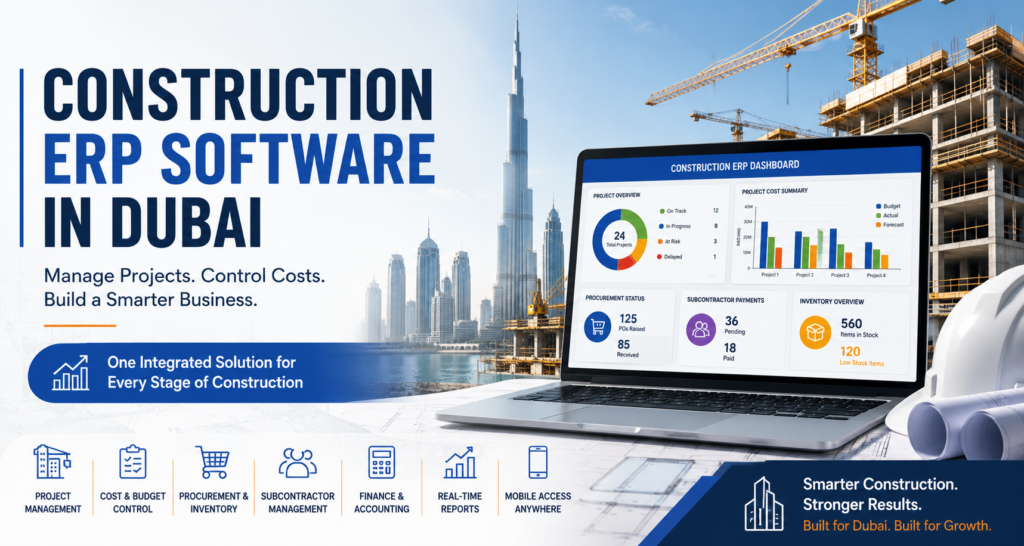
Dubai’s construction industry is continuously evolving, with contractors, developers, engineering firms, MEP companies, and subcontractors managing increasingly complex projects. From procurement and material management to workforce coordination, project costing, subcontractor payments, and financial reporting, construction businesses need complete visibility across every stage of a project.
Managing these activities through spreadsheets, disconnected accounting software, emails, and manual processes can make it difficult to track project profitability and respond quickly to operational challenges.
This is where Construction ERP software in Dubai can make a significant difference.
A modern construction ERP system brings project management, finance, procurement, inventory, human resources, equipment, and reporting into a centralized digital platform. It helps construction companies connect site operations with back-office teams and make decisions using accurate, real-time information. For Dubai-based construction businesses looking to improve efficiency, control costs, and scale operations, implementing the right construction ERP solution in Dubai can become an important part of their digital transformation strategy.
What Is Construction ERP Software?
Construction ERP software is an integrated enterprise resource planning system specifically designed for the requirements of construction and contracting businesses. Unlike a basic accounting application, construction ERP connects financial and operational activities throughout the project lifecycle.
A typical system can manage:
The objective is to create a single source of information so management teams can understand what is happening across projects without depending on multiple disconnected systems.
Why Construction Companies in Dubai Need ERP Software
Construction projects involve many moving parts. A single project may include contractors, subcontractors, suppliers, consultants, engineers, architects, project managers, finance teams, site workers, and clients. When information is distributed across different systems, maintaining accurate project visibility becomes difficult.
A construction management ERP in Dubai can help businesses centralize this information and connect departments.
1. Better Project Cost Control
Project profitability depends heavily on controlling costs. Construction ERP software allows businesses to compare:
This gives project managers and finance teams a clearer understanding of whether a project is progressing according to budget. Real-time budget-versus-actual reporting is a major advantage of construction ERP platforms because management can identify cost deviations earlier instead of discovering them after project completion.
2. Centralized Project Management
Managing multiple construction projects simultaneously can become challenging when each project uses separate spreadsheets and documentation. With ERP software for construction companies, project information can be maintained in a centralized system. Management can monitor:
3. Efficient Procurement Management
Procurement plays a critical role in construction. Late materials can delay site activities, while uncontrolled purchasing can increase project costs. A construction ERP system can connect procurement with project requirements, inventory, budgets, and suppliers.
The workflow can include:
Material Requirement → Purchase Request → Approval → Purchase Order → Goods Receipt → Invoice → Payment
This creates better visibility throughout the procurement cycle.
4. Inventory and Material Management
Construction companies often manage large quantities of materials across warehouses and multiple project sites.
A centralized construction ERP system in Dubai can help track:
This can help reduce unnecessary purchases and improve material planning.
5. Subcontractor Management
Subcontractors are an important part of many construction projects. Managing subcontractor contracts, work progress, certifications, variations, retention, payments, and documentation manually can create administrative challenges.
Construction ERP software can connect subcontractor information with project budgets and financial processes. Companies can track:
This provides management with a clearer view of subcontractor commitments and liabilities.
6. Estimation and BOQ Management
Before a construction project begins, accurate estimation is essential. Construction ERP platforms can help companies manage Bill of Quantities (BOQ) data and connect estimates with budgets, procurement, project execution, and billing. A connected workflow can help businesses move from:
Tender → Estimation → BOQ → Contract → Budget → Procurement → Execution → Billing → Project Closure
This reduces the need to repeatedly enter the same information into different systems.
7. Financial Management
Construction ERP software integrates project operations with accounting and finance. Finance teams can manage:
When financial data is connected with project data, management can better understand the financial performance of individual projects.
8. Real-Time Reporting and Dashboards
Construction management requires timely information. A modern ERP solution for construction companies in Dubai can provide dashboards covering key business and project indicators.
Management dashboards can include:
Instead of waiting for manually prepared reports, decision-makers can access centralized information and identify areas that require attention.
9. Connect Site Operations With Head Office
One of the biggest challenges for construction companies is maintaining communication between project sites and office teams. Site engineers and project managers may generate information about:
An ERP platform can bring these workflows into a connected environment.
Mobile and cloud-enabled ERP capabilities can also make it easier for authorized teams to access project information while working across different locations. Industry examples show construction ERP platforms increasingly connecting site reporting with centralized project and financial data.
10. UAE-Focused ERP Capabilities
Construction companies operating in Dubai need to consider local financial and operational requirements when selecting ERP software. Important areas may include:
A construction ERP should therefore be configured according to the company’s business model and applicable UAE requirements rather than treated as a generic accounting application.
Key Features to Look for in Construction ERP Software in Dubai
Before choosing an ERP platform, construction companies should evaluate whether it provides the following capabilities.
1. Project Management
The system should support multiple projects, project phases, tasks, budgets, progress tracking, and project-level reporting.
2. Cost Control
The solution should allow businesses to compare budgets, committed costs, and actual expenses.
3. Procurement
Procurement workflows should connect material requirements, suppliers, purchase orders, approvals, receipts, and invoices.
4. BOQ and Estimation
The system should support estimation, BOQ management, revisions, and project budget preparation.
5. Subcontractor Management
The platform should provide visibility into subcontractor contracts, progress claims, variations, retention, and payments.
6. Inventory
Construction businesses should be able to monitor materials across warehouses and project sites.
7. Accounting
Financial modules should support project-related revenues, expenses, invoices, payments, receivables, payables, and reporting.
8. HR and Payroll
For organizations with large workforces, ERP integration with HR and payroll processes can help centralize employee and labour information.
9. Mobile Accessibility
Site teams should be able to access relevant information and update project activities without being tied to an office desktop.
10. Analytics
Dashboards and reports should help management understand project performance, financial health, resource utilization, and potential risks.
Construction ERP vs Traditional Software
Many construction companies start with spreadsheets and basic accounting systems because they are simple to use. However, as the organization grows, these tools can become difficult to manage.
| Traditional Approach | Construction ERP |
| Multiple spreadsheets | Centralized database |
| Separate accounting system | Integrated finance |
| Manual project costing | Automated project costing |
| Manual procurement tracking | Integrated procurement |
| Difficult subcontractor tracking | Centralized subcontractor management |
| Delayed reporting | Real-time dashboards |
| Repeated data entry | Connected workflows |
| Limited project visibility | Project-level performance tracking |
| Manual document management | Centralized digital records |
The objective of ERP is not simply to replace spreadsheets. It is to connect business processes so information can move between departments with less manual intervention.
Benefits of Implementing Construction ERP in Dubai
A properly implemented ERP system can provide several business benefits.
Improved Operational Efficiency
Automating repetitive workflows reduces manual administrative work and helps teams spend more time on project execution.
Better Cost Visibility
Management can monitor project costs against budgets and identify deviations earlier.
Faster Decision-Making
Centralized dashboards provide management with access to current operational and financial information.
Improved Collaboration
Finance, procurement, project management, and site teams can work from connected information.
Better Resource Utilization
Businesses can track manpower, materials, equipment, and other resources across projects.
Improved Project Profitability
Better cost control and project visibility can help businesses identify profitability issues earlier.
Scalable Operations
A scalable ERP platform can support additional projects, users, departments, and business entities as the company grows
Who Can Benefit From Construction ERP Software?
Construction ERP solutions can be useful for a wide range of businesses, including:
How to Choose the Right Construction ERP in Dubai
Selecting an ERP system is a long-term business decision. Companies should evaluate more than the software interface or number of features.
Consider these factors:
Industry Experience
Choose a provider that understands construction workflows, project costing, procurement, subcontracting, and site operations.
Integration
Check whether the ERP can integrate with existing accounting, CRM, HR, payroll, procurement, inventory, and other business applications.
Scalability
The platform should be able to support business growth and additional projects.
Customization
Every construction company has different approval processes and reporting requirements. The ERP should provide appropriate configuration and customization options.
Security
Financial and project information is highly sensitive. Evaluate access controls, authentication, backups, data protection, and user permissions.
Implementation Support
Successful ERP adoption depends on implementation, data migration, user training, testing, and post-launch support not just software licensing.
How SKAD AI Innovate Solutions Can Help
SKAD AI Innovate Solutions provides construction ERP software solutions in Dubai designed to help construction and contracting businesses move toward connected digital operations.
The solution can help businesses integrate key functions such as:
By connecting these functions through one centralized platform, construction companies can improve visibility across projects and reduce dependence on fragmented processes. Whether you are managing a single construction project or multiple sites across Dubai and the UAE, an ERP platform can provide the foundation for more structured and data-driven operations.
The Future of Construction ERP in Dubai
The future of construction management is moving toward connected digital platforms, cloud accessibility, real-time analytics, automation, and mobile-first workflows. Construction companies are increasingly looking for systems that do more than manage accounting. They need platforms capable of connecting project execution with finance, procurement, inventory, resources, and management reporting.
Industry examples in the UAE show how construction-specific ERP implementations are being used to connect project costing, procurement, subcontractor management, payroll, equipment, and financial processes. For Dubai construction companies, this digital transformation can create stronger operational visibility and help management make decisions based on reliable business data.
Conclusion
Construction projects require coordination, financial discipline, accurate planning, and continuous monitoring. When critical information is spread across spreadsheets and disconnected applications, maintaining control becomes increasingly difficult. Construction ERP software in Dubai provides a centralized approach to managing projects, costs, procurement, materials, subcontractors, resources, finance, and reporting.
With the right ERP strategy, construction companies can improve operational efficiency, strengthen project cost control, increase financial visibility, and create a scalable technology foundation for future growth.
SKAD AI Innovate Solutions helps businesses explore and implement technology solutions designed around their operational requirements. If your construction company is looking to modernize project management and connect finance, procurement, and site operations, a construction ERP solution can be an important step toward a more efficient and digitally connected business.
Frequently Asked Questions
1. What is construction ERP software in Dubai?
Construction ERP software in Dubai is an integrated business management platform designed for contractors, developers, engineering firms, MEP companies, and other construction businesses. It connects project management, finance, procurement, inventory, subcontractors, resources, and reporting.
2. Why is ERP important for construction companies?
ERP helps construction companies centralize operational and financial information, monitor project costs, manage procurement, track resources, improve reporting, and coordinate different departments.
3. Can construction ERP software manage multiple projects?
Yes. Construction ERP platforms can be configured to manage multiple projects, budgets, resources, procurement activities, subcontractors, and financial transactions from a centralized system.
4. Can construction ERP integrate with accounting software?
Yes. Depending on the platform and implementation, ERP systems can integrate accounting and finance with project management, procurement, inventory, HR, CRM, and other business applications.
5. Does construction ERP support UAE VAT?
A properly configured ERP solution can support UAE VAT-related accounting and invoicing requirements. Businesses should confirm the specific capabilities and configuration with their ERP provider and tax advisers.
6. Is construction ERP suitable for small and medium-sized companies?
Yes. ERP solutions can be scaled according to the size and complexity of a construction business. SMEs can start with the modules they need and expand the system as operations grow.
7. How can I choose the best construction ERP software in Dubai?
Evaluate industry-specific functionality, project costing, BOQ management, procurement, subcontractor management, inventory, accounting, integrations, reporting, scalability, security, implementation support, and the provider’s understanding of UAE business requirements.